

-
Types Of Grease And Their Uses
-

Grease Manufacturing Unit
Types Of Grease And Their Uses
LINUS PROJECTS LIMITED (NIGERIA) is an ISO9001:2015 certified Multinational organization established in the year 2014.
Nigeria is a major exporter of crude oil and petroleum products to various countries. Launching a grease manufacturing venture can yield significant profits if you grasp the concepts of lubricants, formulations, production methods, and the landscape of industrial demand. Grease comes in multiple varieties, mainly distinguished by their thickener or base oil. It is vital for minimizing friction, wear, and tear, along with preventing corrosion in machine bearings and other parts. This not only extends the lifespan of machinery but also reduces maintenance expenses and boosts productivity. In Nigeria, grease is essential to the nation's progress towards establishing itself as a flourishing industrial hub.
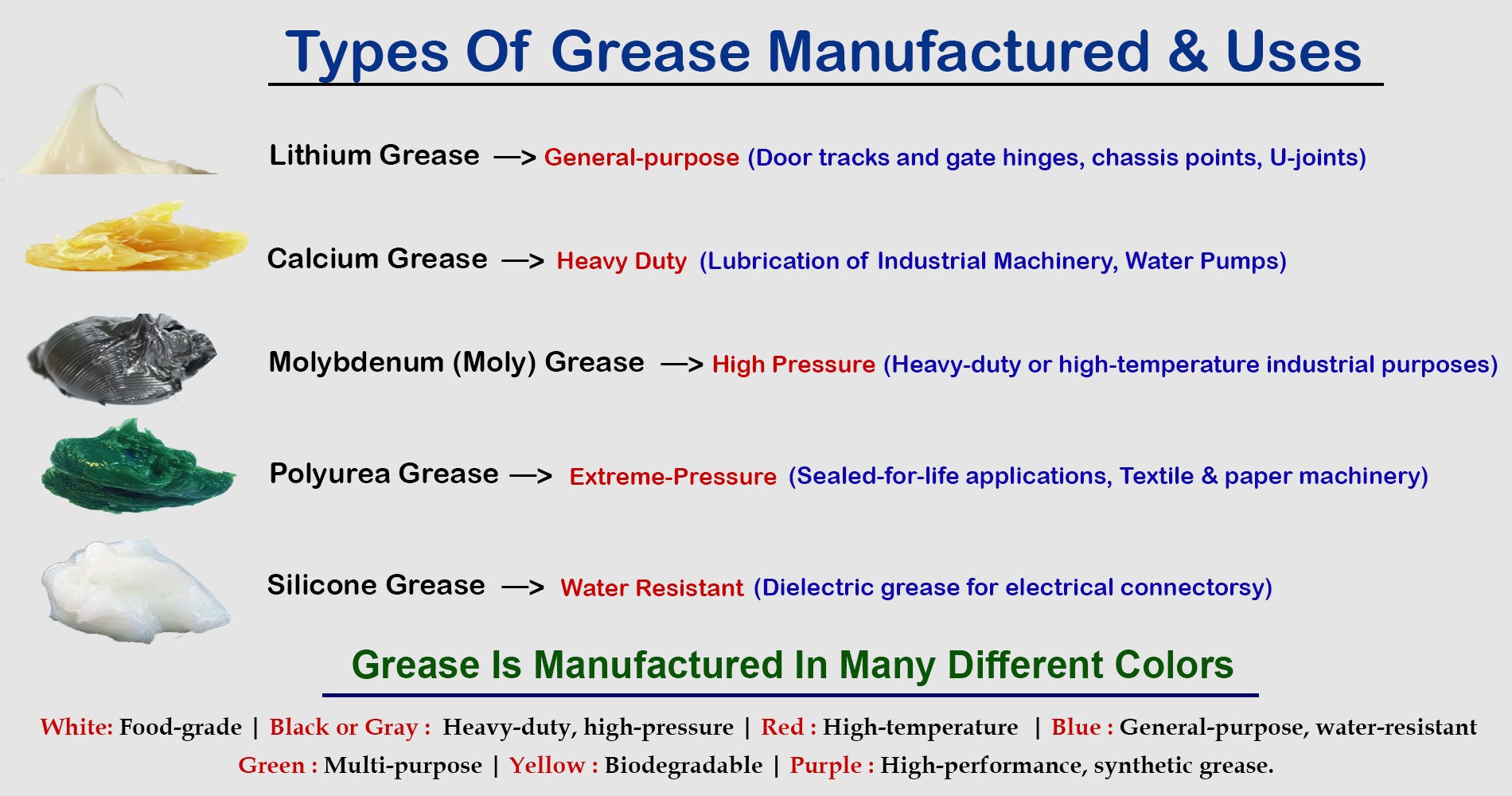
Grease Is Manufactured in Many Different Colors:
Color indicates a specific type or function.
• White: food-grade.
• Black or Gray: Heavy-duty, high-pressure.
• Red: High-temperature or heavy-duty grease.
• Blue: General-purpose, water-resistant.
• Green: Multi-purpose.
• Yellow: Biodegradable.
• Purple: High-performance, Synthetic grease.
| Category | Examples |
|---|---|
| Soap-based | Lithium, Calcium, Sodium, Aluminum, Barium greases |
| Non-soap greases | Clay, Polyurea, Silica greases |
| Specialty | Graphite, Moly, Silicone, Synthetic, PFPE greases |
Soap-Based Greases
Lithium Grease
Lithium grease is produced from the combination of a base oil -commonly mineral or synthetic - with a lithium soap thickener, typically created by reacting lithium hydroxide with fatty acids. It is well-known for its remarkable water resistance, mechanical stability, and capacity to withstand elevated temperatures. This grease is widely applied in automotive, industrial, and household uses.
Basic components required:
1. Base oil (mineral or synthetic)
2. Lithium soap thickener
3. Additives
How Lithium Grease Is Produced — a comprehensive step-by-step procedure
1. Saponification: the fatty acid is neutralized using lithium hydroxide
2. Heating & water removal: the soap typically turns into a gel; water is eliminated through heating
3. Thickening: involves high-shear mixing/kneading followed by cooling
4. Additives and dyes are blended
5. Quality control & packaging.
Key Features:
• Automotive: utilized in wheel bearings, chassis points, U-joints, and for general chassis lubrication.
• Industrial bearings and conveyors: effective for general-purpose plain bearings and roller bearings.
• Agricultural and construction equipment.
• Household applications: including garage door tracks and gate hinges.
Lithium Complex Grease
Lithium complex grease represents a high-performance lubricant created with a complex soap thickener made from lithium salts of fatty acids and low molecular weight dicarboxylic acids. Its elevated dropping point makes it perfect for high-heat, heavy-load, and high-pressure situations. Compared to basic lithium grease, it offers superior protection, enhanced temperature resistance, mechanical stability, and water resistance.
Lithium complex grease is extensively utilized in sectors that demand durability and resistance to high temperatures.
• Automotive Sector.
• Industrial Machinery on Bearing & Gears.
• Construction and Mining Industry.
• Marine and Agricultural Sector.
Calcium Grease
Calcium Grease, also called calcium soap grease or lime-based grease, is one of the oldest and most prevalent types of lubricating grease. It is created by reacting calcium hydroxide with fatty acids to produce calcium soap, which is then mixed with base oil and additives.
This grease is used for lubricating and protecting various machinery, including wheel bearings, chassis, joints, and heavy equipment such as excavators and bulldozers. Its exceptional water resistance and corrosion protection make it particularly valuable in the marine, construction, and automotive sectors.
Types of Calcium Grease
1. Hydrated Calcium Grease (with Water)
2. Anhydrous Calcium Grease (without Water)
• Lubricating Bearings for electric motors, fans, and pumps.
• Lubricating vehicle Gear and industrial machinery.
• Lubrication of wheel bearings, steering gears, and brakes.
• Food-grade calcium grease is used for the lubrication of machinery.
Aluminum Complex Grease
Aluminum complex grease is formulated by using aluminum complex soap as the thickening agent, combined with base oils (often high-viscosity oils) and specific additives for extreme pressure and anti-wear capabilities. The production involves a chemical reaction to create the aluminum complex soap thickener, which is then blended with base oil and additives to produce a smooth, gel-like grease that boasts high water resistance, excellent temperature stability, and strong corrosion protection. Commonly Used in Automotive Wheel bearings, Industrial Electric motor bearings, Pumps, compressors, and couplings.
1. Exceptional stability at high temperatures.
2. Outstanding resistance to water washout.
3. Protection against corrosion.
Barium Complex Grease
Barium complex grease is produced by saponifying fatty acids or fats using barium hydroxide. Essentially, the grease comprises base oil, a barium complex thickener, complexing acid, and various additives.
This grease is distinguished by its mechanical stability, water resistance, and its ability to function under heavy loads while being exposed to moisture and chemicals. It is used in water pumps, high-speed bearings in the textile, packing industries, and mechanisms that are exposed to water vapors.
Sodium Grease
Sodium grease is a form of lubricating grease that is thickened using sodium soap, which is usually derived from sodium hydroxide (NaOH) and fatty acids. It is recognized for its excellent heat resistance, lubricating properties, and shear stability, although it has limited water resistance, which restricts its application in moist conditions. At times, it is mixed with calcium or lithium greases to enhance water resistance while maintaining cost-effectiveness.
• Industrial machinery with low levels of water exposure.
• Rolling mills and press operations.
• Bearings designed for dry environments (e.g., electric motors, fans).
• Lubrication of chassis in older automobiles.
• Agricultural machinery.
Graphite Grease
To produce graphite grease, a base oil such as mineral oil or synthetic oil is combined with a thickener like lithium, calcium, sodium, or aluminum soap. Additionally, micro-sized natural or synthetic graphite powder is incorporated along with additives like antioxidants, rust inhibitors, and antiwear agents to create a robust, solid grease. This grease is especially beneficial in situations that face heavy loads, high pressure, or elevated temperatures, as it offers lubrication, minimizes friction, and safeguards against wear and corrosion.
Non-Soap Greases
Polyurea Grease
Polyurea grease is a synthetic grease that does not contain soap, created by the reaction of amines with isocyanates. It is prized for its excellent thermal stability, resistance to oxidation, and extended service life, which makes it perfect for high-demand and sealed-for-life applications. Polyurea greases serve as alternative lubricants designed for scenarios that do not necessitate Extreme-Pressure (EP) additives and are frequently utilized in electric motors.
• Electric motor bearings.
• Automotive wheel bearings.
• Fan & pump bearings.
• Textile & paper machinery.
• Sealed-for-life applications, eliminating the need for re-lubrication.
Clay (Bentonite) Grease
Clay grease, commonly referred to as Bentonite grease, is a type of non-soap grease that is thickened using Bentonite clay. Unlike traditional greases that rely on soap-based thickeners, bentone (or bentonite) grease utilizes clay, providing it with exceptional resistance to very high temperatures and so its highly valued in heavy load Industries. The base oil is infused with bentonite clay, often through high-shear mixing, and occasionally with the help of a polar activator to boost stability and consistency.
• Bearings in the automotive and industrial sectors that face high heat exposure.
• Bearings designed for electric motors.
• Bearings utilized in oven conveyor systems, kilns, and foundries.
• Machinery for mining and construction purposes.
• High-temperature areas in cement and steel production facilities.
Synthetic Grease
Synthetic grease is an advanced lubricant produced by combining synthetic base oils or ester oils with a thickener such as lithium complex and various additives to enhance performance in extreme conditions. These additives may include anti-wear agents, corrosion inhibitors, and extreme pressure additives. Synthetic grease offers many advantages over petroleum-based greases in different technical aspects. Synthetic grease is especially effective in environments where friction and heat are prevalent.
• Automotive sector focusing on wheel bearings, chassis components and electric motors.
• Aviation and aerospace industry specializing in aircraft bearings.
• Industrial machinery encompassing motors, chains, winches, conveyors, and robotics.
• Marine equipment featuring propeller shafts.
• Food machinery sector.
Silicone Grease
Silicone grease is a type of lubricant that does not melt and is resistant to water, created by thickening polydimethylsiloxane (PDMS), which is a silicone oil, with a silica-based thickener, usually amorphous fumed silica. It is widely utilized in plumbing, automotive, laboratory, electrical, industrial, and household door hinges, drawer slides, appliance seals due to its remarkable characteristics, which include thermal stability, resistant water penetration, electrical insulation, resistant to chemical reactions, and compatibility with most rubbers, excluding silicone rubber.
• Serves as a dielectric grease for electrical connectors.
• Lubricates Electrical & Electronics faucet valves, O-rings, and rubber seals.
• The automotive industry protects against wear on rubber gaskets and weather seals.
• Suitable for Medical valves and seals due to its chemical resistance.
• Protects metal and rubber parts from saltwater corrosion in the Marine Industry.
Molybdenum (Moly) Grease
Molybdenum grease can be either soap-based or non-soap. It is mostly a non-soap grease additive, but the base grease can be either type. Soap-based moly grease uses a lithium soap thickener. On the other hand, non-soap moly grease makes use of a non-soap thickener, such as bentonite or clay. Non-soap greases are known for their enhanced temperature resistance and water resistance, which are ideal for industrial and heavy machine applications.
• Soap-based Molybdenum grease is applied in automotive chassis and bearings.
• Non-soap Molybdenum grease is used for heavy-duty or high-temperature industrial purposes.
Bio-Based Grease
Is manufactured from a vibrant mix of renewable resources, including animal fats, vegetable and flower oils, soybean oil, rice bran oil, and castor oil. Decreasing dependence on fossil fuels. However, not every bio-based grease is naturally biodegradable.
• Outstanding thermal and oxidative stability.
• Advanced protection from rust and corrosion.
• Environmentally Friendly, Biodegradable and low toxicity.
Types Of Grease and their Uses PDF
We have launched training for our clients who have partnered with us in the production of various types of Grease. Our clients have successfully designed and introduced a wide array of Grease under their brand name, realizing significant profits. Our primary strength is rooted in our strong technological foundation, established infrastructure, dedicated teamwork aimed at delivering High Caliber Products, and a relentless drive for excellence.
 Download Types Of Grease and their Uses PDF
© Copyright 2024 All Rights Reserved. Linus Projects Limited Nigeria